Showing posts with label Classical art study. Show all posts

Thursday, September 12, 2013

Mums with Large Vase and Ginger Jar

Did I say I joined the 30 day challenge?

Yes I did, and I finally have 'a' painting that I can actually claim to have painted this month!

I worked on this about three days and I am going to make it count even though I finished on day 12... Geezzzzz
 To continue...
I worked on this with a very limited palette. I was intended to try the 'Zorn Palette', but found it less appealing the more I worked with it. Soooooo... instead of using ivory black, I mixed my black with transparent red oxide and ultramarine blue. I tuned my yellow ochre with some cadmium yellow light, and used only a small bit of vermillion which I did not change, and actually only used a smidge of it since the TRO was more useful on this arrangement. Last, but not least, included in the 'Zorn Palette' is white.

My point in this explanation is that a limited palette can be a blessing when it comes to creating harmony, but also a darn curse if you crave more color as I did in this painting.

(The blue areas would have been black and shades of gray if I didn't make the changes explained earlier.)

Mums in Large Vase w/Small Ginger Jar - SOLD
11 x 14 Oil on Canvas Panel
@ 2013

Saturday, August 17, 2013

Master Study II - Rubens

The first time I did a master study was of the painting by Antonio Mancini, titled Resting.

This time I chose a painting by Peter Paul Rubens, titled The Last Supper. I am so taken by this one painting, that I view it every time I visit the Seattle Art Museum.
This link
will take you to the SAM web page of the image.

There are several other studies and paintings of this subject that Rubens and other painters have done throughout history, but this ONE I find incredibly special.

The perspective and arrangement of the group of men (the disciples) listening to the words  of Jesus (Yeshua, their rabbi and spirital teacher) is so perfectly presented. It literally elevates the importance of the words he is conveying to them. It is as if he is telling them a secret, and I want to hear too. The movement, and use of color are simply beautiful.

 
The Last Supper - Rubens (borrowed from web images)

Part of my motivation to paint this is to build on my understanding of the geometry in classical painting. So since Rubens is not taking any new live students at this time, I was trying to figure out how to obtain an image that would be more helpful than a printout of a web image. Then I decided to contact the Seattle Art Museum to see if they could assist.

Yes, was their reply!

I agreed to sign a use agreement, and for a small fee, they will send me an image through the mail that I will use for reference. I can hardly wait to get started! Thank you Seattle Art Museum.

OMGosh! I better get started on sizing and stretching my canvas...


Saturday, August 10, 2013

Step One - Classical Geometry Yellow Bowl, Poppies, and Onion

So here you have it. I've made my first step into the world of 'consciously' using classical geometry for composition.

Because I have so many canvas panels of proportions set by today's standards such as
6 x 8, 8 x 10, etc., I decided to simply use a grid that would divide the space by similar means without going to the phi rectangles, and root rectangles as the Masters did. This grid is known as a 'harmonic armature'.

So in my simple way this painting is the result selecting random objects placing along the grid lines. 
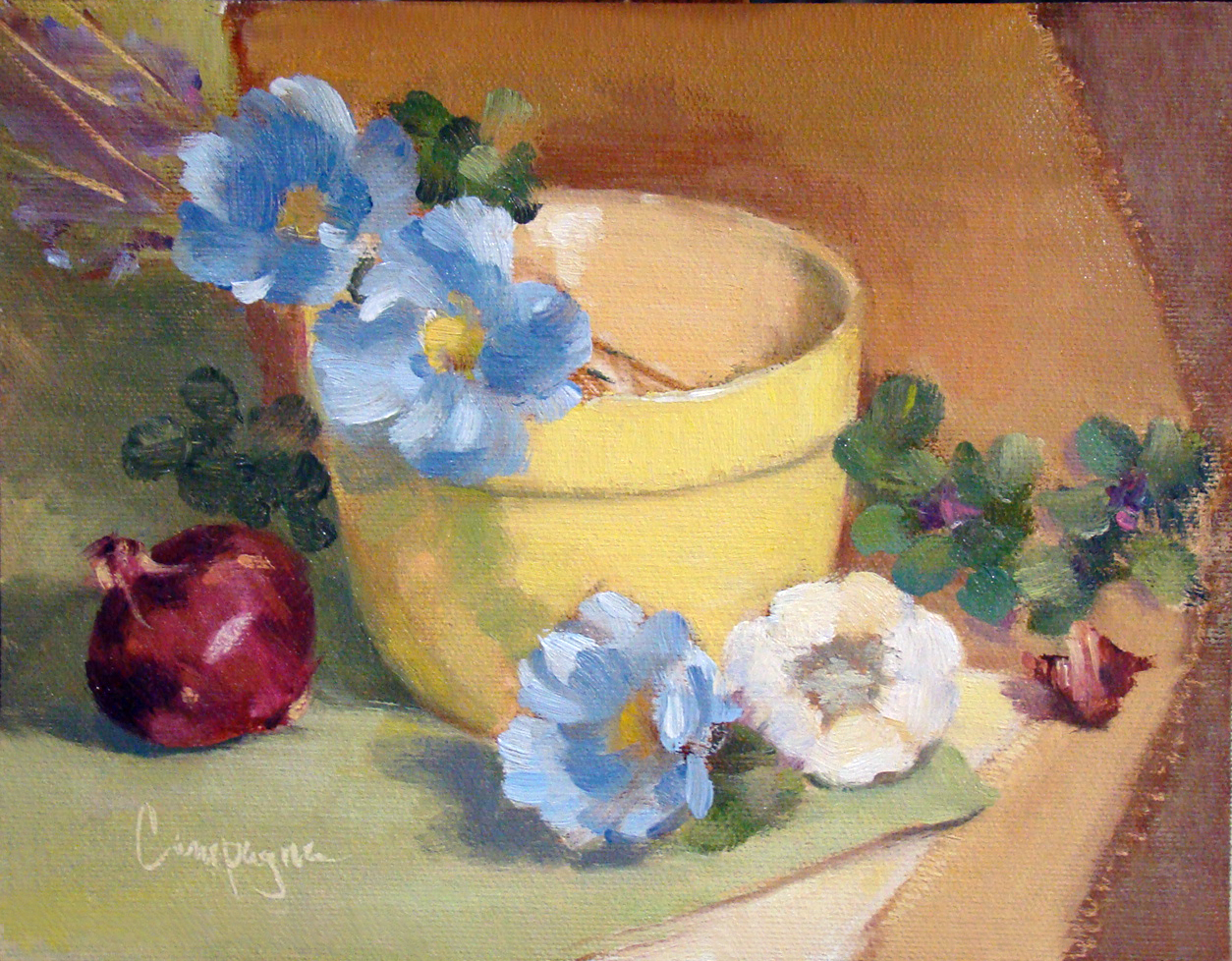
Yellow Bowl I
9 x 7 Oil on Canvas Panel
© 2013

The canvas panel was an 8 x 10 cut down to 9 x 7 inches; the color palette includes ultramarine blue, cad scarlet, cad yellow light and quinacridone magenta, and white - It is not a true use of the Fletcher system, but I did consider it when choosing the colors.

So back to the classical geometry...

When I did graphic design, grids were used to help arrange elements on the page for readability, and sometimes we tried to squeeze in a little something for visual interest that was less rigid. In this situation I just went with the grid similar to what the old masters may have used in designing their compositions.

This next image shows that grid superimposed to demonstrate what I mean. I did not consider the 'do not' put things in the middle of the picture plane, and 'do not' divide the picture plane in half. I just did what the grid suggested with an occasional 'offset' to keep from getting a headache. ;o)
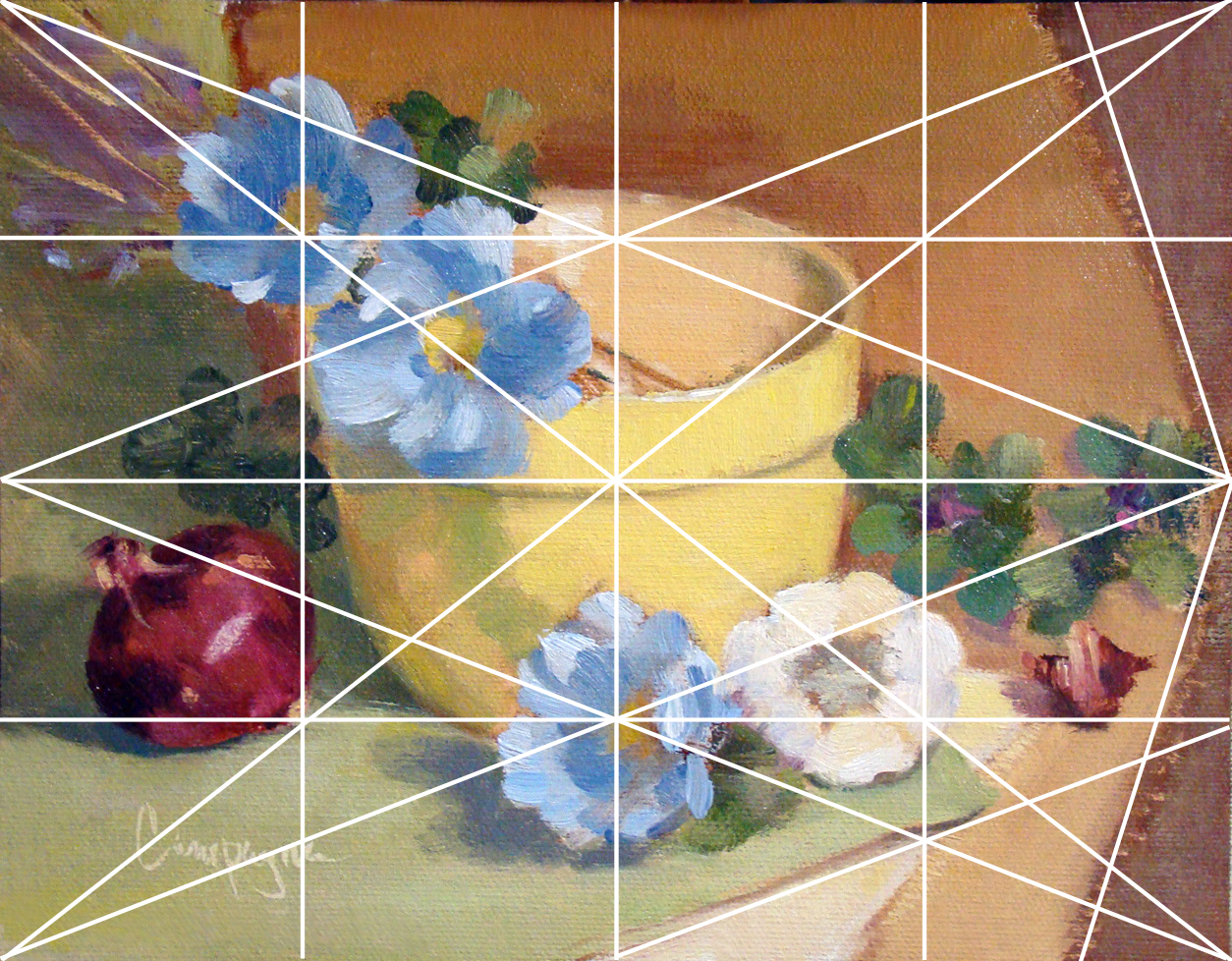
Grid_Yellow Bowl for demonstration purposes.


Several lines are left out with only major points emphasized like elements on the diagonal and and reciprocal (repeated) diagonals. Each of those smaller rectangles are exactly the same ratio as the main panel which I find rather interesting though this is probably obvious to math enthusiasts. (BTW, this grid is not the rule of thirds that artists sometimes default to when composing an image.) I believe 'harmonic armature' is the correct term for this type of grid - think of it like musical notes e.g., half notes, quarter notes, etc.

Since I did this painting myself using basic information, it is a little difficult to critique as good or bad. Of course, I do wonder what may have happened with this layout if I was not using a grid. My first thought is I may have put the bowl to the left and made other decisions about placement for the remaining objects. I do think I may be able to get more depth of field by changes in proportions with or without the grid - hmmmm.

There are other grid options of course, but I just went with 4, 8, etc. Eventually, I will attempt one in thirds and follow a similar breakdown - perhaps using like objects to see if the result is noticeably different.

As I get more comfortable with this way of looking at composition I will learn to include arches and semi-circles to move the eye through the picture plane, my hope is to create images that are more visually compelling for the viewer.

In any case, I welcome your feedback and hope you enjoyed this little demo on using a basic grid.

Saturday, July 20, 2013

Sacred Geometry in Classical Art

Mathematical studies of the Fibonacci Series and golden section/sacred geometry is not usually the priority for a fine art painter of today. We moderns don't think about sacred geometry too much - we mostly enjoy the act of painting and kinda ballpark the rule of thirds in our layout, and most often come up with pleasing compositions as we paint on the standard canvas sizes carried by art suppliers.

But I've been thinking a lot about the geometry used in classical art that defined the composition. The classic masters did use it. Learning how to draw a root2 or phi rectangle doesn't create a beautiful painting in itself, it does help us with proportions that can be used like a template to suit and support the original concept of the painting. Graphic design uses templates for columns and page layout, so why not fine art painting.

This youtube video may be a bit overstated with all the triangulations, but I do think it makes the point that the old masters used geometry in their work - sacred or not. 


Note: These lines are only to show points of interest in the overall two dimensional picture plane, and not intended to suggest perspective for a three dimensional illusion. Perspective and its lines of delineation are a separate area of study.

Saturday, July 06, 2013

Study of the classical renewed...

Since seeing the Rembrandt painting at the Seattle Art Museum (the Kenwood House Collection) this past Spring, I've become more and more curious about classical work regarding the methods of the old masters.

Rembrandt - Self Portrait
Oil on Canvas
ca. 1665

The self-portrait of Rembrandt is engaging. The composition, the quality of paint, everything about this painting screams at me, but the language sounds foreign. His small etchings had/have a quality that is compelling in a similar way. The other paintings in the show had/have something intriguing about them too - none of which I could quite put my finger on as a modern viewer... and in spite of years of art training, I felt inadequate - like something was missing in my understanding. Let me explain...

Selecting objects for a still life is always an exercise that challenges me. I see beauty in so many things and want to express it in a pleasing way that you might see it too. After selecting items, working with how do I arrange them - what size do I paint - and after  coming up with a passable solution, it changes several times during the process. And this I've discovered is one of the interesting things about classical work.

In a classical painting there is an underlying framework for composing the painting. You've heard of the 'golden section' or 'divine proportion', but there is a tremendous amount more to it, and many of us more modern painters have no idea about how to utilize it like the masters did for our compositions. Could it really make for better paintings and perhaps achieve a true masterpiece?

This process was used in painting and sculpture and all manner of the arts. Just like learning an instrument and or movements in dance, there are scales and fundamentals that one needs to learn before they can perform beautifully. The same goes for painting.

I know we always hear suggestions about selecting random elements and being spontaneous for my paintings, but for me this results in sooooo many failures and disappointments. So now, I fear I will become a snob of sorts rejecting efforts that are not 'designed' in a more classical way. ;o)

I have a good sense of layout as a graphic designer, but even this seems basic and not very artistic or satisfying with our modern way of doing things. I enjoy painting very much, but when I begin to paint I often ask myself if the world really needs another oil painting. Maybe not...?

However, for my next several painting efforts, my plan is to revisit some past images of my own doing to start from, and begin to learn how to actually 'design' a painting like the Masters might have done - using the same objects, and see if it makes a difference. Sounds like work, but what the heck - I like a good challenge.

BTW, the study resources I plan to use are based on the Barnstone Studio program. He has some free videos to preview on his site that immediately rang true for me.

During the next several posts I will share my experiences with this study.